
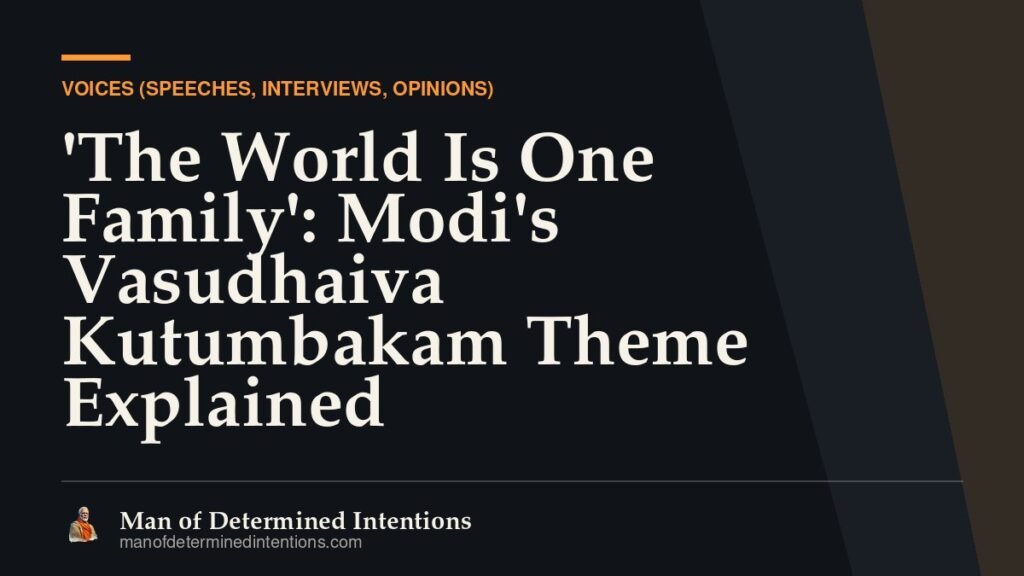
Among the recurring phrases in Modi’s global diplomatic speeches, one ancient Sanskrit line stands out for having become an official government theme rather than remaining just a rhetorical flourish. This article explains where “Vasudhaiva Kutumbakam” comes from and how Modi’s government has used it.
The Phrase’s Ancient Origin
“Vasudhaiva Kutumbakam” comes from the Maha Upanishad, an ancient Sanskrit text, specifically from a verse reading, in translation, “This is mine, that is theirs, such is the reckoning of the narrow-minded; for those of noble character, the entire world is one family,” according to the verse’s widely cited textual source. The phrase itself translates roughly to “the world is one family,” a concept considerably older than its recent adoption into contemporary Indian foreign-policy branding.
Becoming India’s Official G20 Theme
The phrase’s most prominent recent use came when India assumed the G20 presidency for the period December 1, 2022 to November 30, 2023, with the government formally unveiling “Vasudhaiva Kutumbakam — One Earth, One Family, One Future” as India’s official G20 theme, according to a Press Information Bureau release announcing the theme, logo, and website launch. The theme was explicitly linked to environmental and sustainability messaging through the government’s parallel “LiFE,” or Lifestyle for Environment, initiative, with official language framing the concept around recognising, in the government’s own words, “the worth of all living entities, humans, animals, plants, and microorganisms” and their fundamental interdependence.
Also read: Modi's G20 Summit Speeches: India's Message to the World
How the Theme Structured the G20 Summit
During the New Delhi G20 Summit in September 2023, Modi chaired leader sessions organised explicitly around the theme’s three component sub-themes, “One Earth,” “One Family,” and “One Future,” using the ancient phrase as a structural framework for the summit’s formal proceedings rather than only as an opening rhetorical flourish, a deliberate choice to build actual summit architecture around Indian civilisational language rather than more conventional, generic summit branding.
Theme Versus Formal Text: A Notable Gap
Despite functioning as the G20’s official India-presidency theme, reporting by outlets including Deccan Herald and Bloomberg noted that the Sanskrit phrase itself was largely absent from the G20’s actual binding joint declarations and formal documents, with some analysis attributing this gap to friction over India-associated cultural branding appearing in shared multilateral text that other member countries, including China, would also need to formally endorse. This represents a genuine “theme versus substance” distinction worth noting: the government’s framing emphasised the phrase’s civilisational soft-power value and universal appeal, while some analysts pointed to the gap between prominent symbolic branding and what the actual formal G20 text ultimately contained.
Other Contexts Where the Phrase Recurs
Beyond its formal G20 role, Modi has invoked “Vasudhaiva Kutumbakam” more generally across various diplomatic and domestic speeches over the years as a recurring shorthand for India’s stated foreign-policy philosophy of universal inclusion and non-discrimination between nations, a rhetorical habit that predates the G20 presidency and has continued in speeches since, though it received its single most concentrated and formalised expression through the 2023 G20 theme specifically.
Read this next: Mann Ki Baat: Complete Episode Timeline and Key Themes
The Phrase’s Use Beyond the G20
While the G20 presidency gave “Vasudhaiva Kutumbakam” its single most concentrated and formalised expression, Modi has invoked the phrase in various other diplomatic and domestic contexts over the years as a general shorthand for India’s stated foreign-policy philosophy of universal inclusion, a usage pattern that predates the 2023 G20 presidency and reflects a longer-standing rhetorical habit rather than a phrase adopted specifically for that one presidency. This broader, recurring use is part of why the government was able to draw on it so naturally as an official theme, since it was already a familiar part of Modi’s diplomatic vocabulary rather than an entirely new coinage introduced for the occasion.
Why India Chose an Ancient Phrase Over Modern Diplomatic Language
The decision to build an entire G20 presidency’s branding around a Sanskrit phrase from an ancient philosophical text, rather than more conventional, modern diplomatic language, reflects a broader pattern in how the Indian government has approached its recent global messaging: consistently drawing on India’s civilisational heritage as a source of soft power and distinctiveness on the world stage, a strategy visible not only in the G20 theme but in other instances of ancient Indian concepts, from yoga’s global promotion through International Yoga Day to Ayurveda-related initiatives, being positioned as India’s specific contribution to global governance and culture, rather than relying solely on contemporary economic or strategic arguments for India’s growing international standing.
Bottom Line
“Vasudhaiva Kutumbakam,” an ancient Sanskrit phrase from the Maha Upanishad meaning “the world is one family,” became India’s official G20 2023 presidency theme, structuring the New Delhi Summit’s formal sessions around its “One Earth, One Family, One Future” framing and linking it explicitly to environmental sustainability messaging through the government’s LiFE initiative, even as some reporting noted the phrase itself was largely absent from the summit’s actual binding joint declarations, illustrating a gap between prominent civilisational branding and formal multilateral text that both reflects the theme’s soft-power value and its practical limits within consensus-based international documents.
Disclaimer: This article is based on official government records and news reports listed below. It is written for general informational purposes and does not represent an official statement from the Government of India or the G20 Secretariat.
Sources
FAQ