
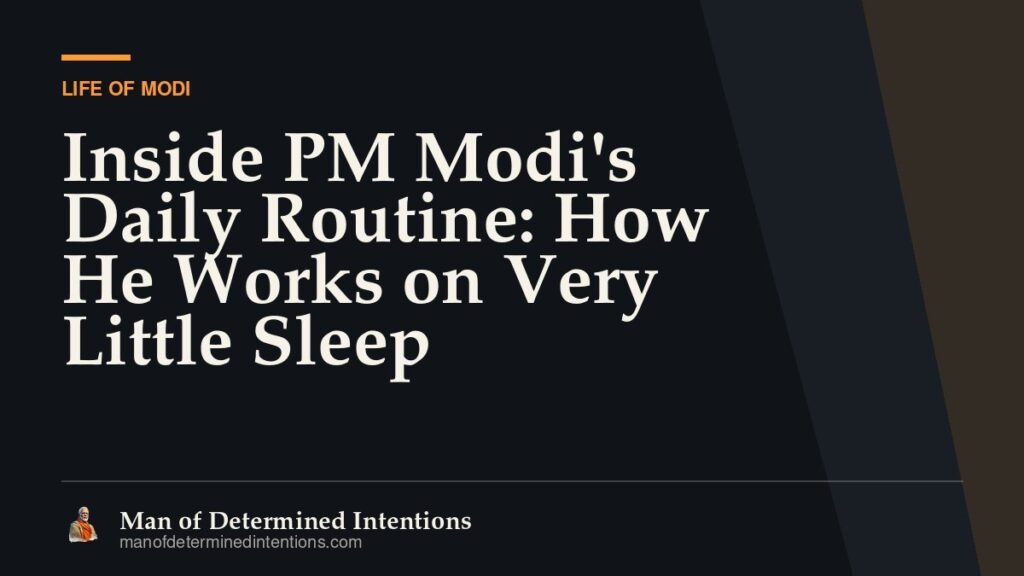
Most adults are advised to get seven to nine hours of sleep a night. By multiple public accounts, Narendra Modi gets closer to three and a half.
That single figure is what gets repeated most often about his routine, but it’s worth looking at the fuller picture: what he actually does with his waking hours, and how much of the popular “18-hour workday” description holds up.
The Sleep Number, and Where It Comes From
References to Modi sleeping around 3.5 to 5 hours a night have come up repeatedly over the years, including from union ministers and in Modi’s own public conversations, such as his 2024 interview with podcaster Lex Fridman. His day is widely reported to begin around 4 am.
It’s worth being careful here. There isn’t a single official, continuously updated record of exactly how many hours he sleeps every night, and this kind of figure inevitably varies day to day depending on travel and schedule. What can be said with more confidence is that multiple independent sources, across several years, converge on the same rough range: short nights, an early start.
Also read: Why Narendra Modi Practices Yoga Every Day
Morning Routine
Mornings reportedly begin with yoga and Surya Namaskar (a sequence of sun-salutation postures), followed by a period of meditation. Brisk walking is also mentioned frequently as part of his morning routine.
Breakfast, by several accounts, tends to be simple: a cup of ginger tea to start, followed by light, homely food. This fits a broader pattern in how his diet is described, which we cover in more detail in a separate article on his food and fasting habits.
A Working Day With Few Breaks
Once the morning routine is done, the day fills up with meetings, official engagements, and travel. Modi is frequently described by officials and biographers as one of the more relentlessly scheduled heads of government, with very few personal holidays across his years as Chief Minister and then Prime Minister.
One detail that recurs in descriptions of his working style: he reportedly avoids eating after 6 pm, sticking to a modest, largely vegetarian diet through the day, and continues working, often past midnight.
The Franklin Comparison
In one revealing moment, Modi is reported to have recommended Benjamin Franklin’s famous daily schedule to Uttar Pradesh’s cabinet as an example worth studying, Franklin’s routine being built around a fixed early wake time, a structured block of work, and a nightly self-review of the day’s progress. It’s a small detail, but it points to something consistent in how Modi talks about his own time: less about heroic effort and more about a rigid, repeatable structure applied every single day without exception.
Read this next: Why Narendra Modi Is Known for Working Without Vacations
That framing matters, because it’s the part of his routine that’s actually replicable. Most people can’t and shouldn’t try to run on 3.5 hours of sleep. Almost anyone can try keeping a fixed wake time and a non-negotiable morning block for exercise.
Should Readers Try to Copy This?
It’s worth a plain, honest note here: sleeping 3.5 to 5 hours a night is not something sleep researchers would generally recommend as a healthy target for most people. Chronic short sleep is linked to a range of health risks over time. Modi’s routine is often shared online as an inspirational productivity story, but it describes what one specific, unusually high-pressure public office looks like for one individual, not general health advice.
If you’re reading this because you want to be more productive, the more transferable lessons from what’s documented about his routine are probably the structural ones: a consistent wake time, a fixed morning exercise block that isn’t skipped, and an early, light dinner, not the sleep-deprivation part specifically. Sleep researchers generally agree that consistency in wake time matters almost as much as total hours, which may partly explain how a short but fixed sleep window is sustained over decades without the routine visibly breaking down.
Travel Doesn’t Seem to Change the Pattern
International trips, which typically wreck most people’s sleep schedules through jet lag, don’t appear to loosen this routine much either. Reporters travelling with the Prime Minister’s delegation on foreign visits have repeatedly noted early-morning public appearances and yoga sessions maintained even directly after long-haul flights across multiple time zones, suggesting the structure is treated as close to non-negotiable rather than something that flexes around travel fatigue.
Bottom Line
What’s documented about PM Modi’s daily routine points to an early start, a short and specific window of sleep, a consistent morning yoga and walking practice, and a long, meeting-heavy day that regularly runs past midnight. The sleep figure is the most attention-grabbing detail, but it shouldn’t be read as a routine to replicate. It’s a description of one demanding job, not a wellness recommendation.
Disclaimer: This article is based on publicly available interviews, official statements, and news reports listed below. It is written for general informational purposes and does not represent an official statement from the Government of India or the Prime Minister’s Office, and it is not medical advice.
Sources
FAQ
How many hours of sleep does PM Modi get?
Multiple public accounts, including his own comments in interviews, put it at roughly 3.5 to 5 hours a night, though there’s no single official daily record.
Does PM Modi take vacations?
By most accounts from officials and biographers, he takes very few personal holidays, both as Chief Minister of Gujarat and as Prime Minister.
Is Modi’s sleep schedule considered healthy?
No. Sleeping 3.5 to 5 hours a night falls well short of the 7 to 9 hours generally recommended for adults, and it shouldn’t be read as health advice.