
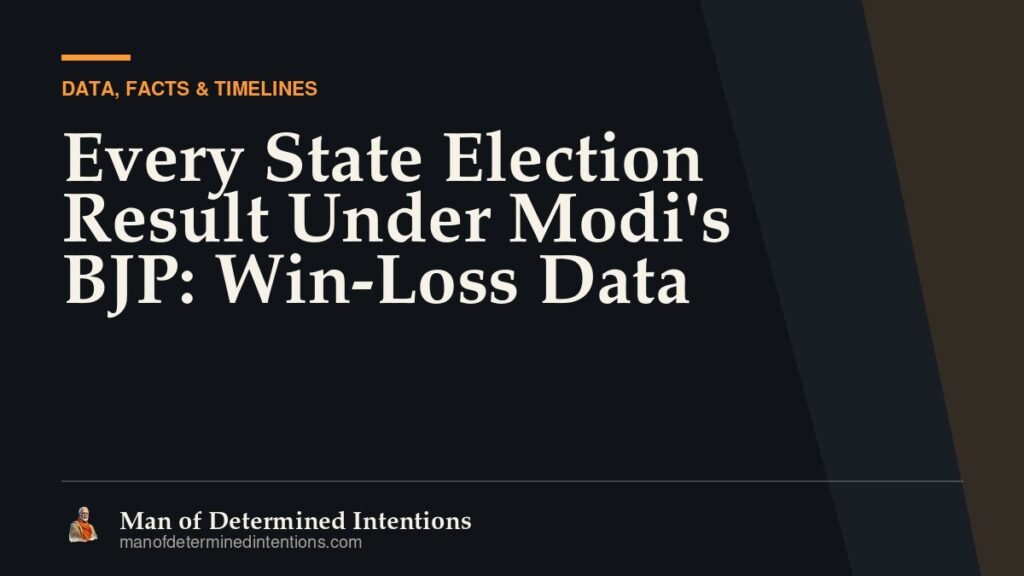
State assembly elections happen on a rolling basis across India almost every year, and BJP’s record in them since 2014 is a genuine mix of landslide wins and significant losses rather than an uninterrupted winning streak. This article compiles the major results into one place.
The Big Wins
BJP’s most decisive state wins under Modi’s national leadership include Uttar Pradesh in 2017, where the party won 312 of 403 seats, a landslide by any standard, according to Wikipedia’s election records, and again in 2022 with 255 seats, retaining power under Chief Minister Yogi Adityanath. Gujarat’s 2022 election delivered BJP a record 156 of 182 seats, its highest-ever tally in Modi’s home state, described by Deccan Herald as the party recording its “highest-ever vote share” there. Madhya Pradesh in 2023 gave BJP 163 of 230 seats, which The Quint called a “mammoth victory.” Maharashtra’s 2024 election saw the BJP-led Mahayuti alliance sweep, with BJP alone winning 132 seats. Haryana 2024 delivered what Outlook India described as a “historic” third consecutive BJP term, defying exit polls that had favoured Congress. Odisha’s 2024 result was arguably the most significant single breakthrough of the decade, with BJP winning an outright majority and ending the Biju Janata Dal’s 24-year rule under Naveen Patnaik, the party’s first-ever government in that state.
The Comeback and Breakthrough Wins
Delhi’s 2025 election marked BJP’s return to power after 27 years, ending AAP’s decade-plus rule, with the party winning 48 of 70 seats, a result Al Jazeera and other outlets covered as BJP “storming back to power.” West Bengal’s 2026 election, per Wikipedia’s compiled results, saw BJP win a majority and unseat the Trinamool Congress after 15 years in power, with Suvendu Adhikari sworn in as chief minister, a genuinely historic first for the party in that state. Assam’s 2026 election saw the NDA, led by BJP under Chief Minister Himanta Biswa Sarma, retain power with a comfortable majority, according to Wikipedia’s final tally, though it’s worth noting that same-day live-count figures reported by outlets including India TV and Republic World during the counting process varied somewhat from the final certified numbers, a common pattern in Indian election-night reporting before all rounds are counted.
Also read: Narendra Modi's 2019 Re-Election: How BJP Won an Even Bigger Mandate
The Notable Losses
BJP’s setbacks have been just as real as its wins. Delhi 2015 was an early landslide loss to AAP, described by Al Jazeera as the ruling party “conceding defeat” decisively. Bihar 2015 saw the BJP-led alliance lose to the Nitish Kumar-Lalu Prasad Grand Alliance. Himachal Pradesh 2022 went to Congress, which won 40 seats against BJP’s 25, a loss of incumbency for the party. Karnataka 2023 was a clear defeat, with WION reporting Congress winning an “absolute majority” and unseating BJP. Telangana 2023 saw Congress unseat the incumbent BRS, with BJP finishing a distant third. Jharkhand’s 2024 election went to the JMM-led INDIA bloc under Hemant Soren, a clear BJP loss according to Outlook India’s coverage. West Bengal’s 2021 election, before the party’s later 2026 breakthrough, saw Trinamool Congress under Mamata Banerjee win comfortably despite BJP’s gains that year.
The Overall Trend
Taken together, BJP or its NDA allies governed roughly 7 states when Modi became Prime Minister in 2014. By early 2025, according to Business Standard’s analysis, that figure had grown to 21 states and union territories, covering close to 72 percent of India’s population, a scale of dominance the outlet compared to Congress’s federal reach under Indira Gandhi in the late 1970s. Of these, India TV’s February 2025 count found BJP governing 15 states and union territories directly, including Uttar Pradesh, Maharashtra, Madhya Pradesh, Gujarat, Rajasthan, Odisha, Assam, Chhattisgarh, Haryana, Delhi, Uttarakhand, Tripura, Goa, Arunachal Pradesh, and Manipur, with NDA allies governing several more, including the Telugu Desam Party in Andhra Pradesh and the Janata Dal (United) in Bihar.
Read this next: Number of Rallies Addressed by Modi in Every Election Since 2014
Why the Numbers Move Around So Much
It’s worth being cautious about treating any single point-in-time count of “states governed” as a fixed number, since assembly elections happen on staggered cycles almost every year, meaning the total shifts within months of any snapshot being reported. A state counted as BJP-governed in one year’s tally can flip in the next round, as happened with Karnataka, Himachal Pradesh, Telangana, and Jharkhand switching away from BJP even as the party gained Odisha, Delhi, and West Bengal in the same broader period, underscoring that state-level political fortunes in India remain genuinely competitive rather than settled in either direction.
Coalition States Versus Direct Rule
Not every state on BJP’s tally represents a straightforward outright majority for the party itself. India TV’s February 2025 breakdown distinguished between roughly 15 states where BJP governs directly and several more, including Andhra Pradesh, Bihar, Meghalaya, Nagaland, Sikkim, and Puducherry, where BJP governs as part of a coalition led by or shared with regional allies such as the Telugu Desam Party and Janata Dal (United), meaning the party’s overall national footprint depends partly on alliance arithmetic rather than independent electoral strength in every single state counted.
If you like this, you must read: India's Vote Share Trend: BJP Performance 2014 vs 2019 vs 2024
Bottom Line
BJP’s state election record under Modi has been a mix of landslide wins, including Uttar Pradesh, Gujarat, and the historic Odisha and West Bengal breakthroughs, and clear losses in states including Karnataka, Himachal Pradesh, Telangana, and Jharkhand, with the party’s overall footprint growing from roughly 7 states in 2014 to around 21 by the mid-2020s even as individual states have continued to swing in both directions.
Disclaimer: This article is based on publicly available Election Commission of India data and news reports listed below. It is written for general informational purposes and does not represent an official statement from the Government of India or the Election Commission of India.
Sources
FAQ
How many states does BJP govern today compared to 2014?
Roughly 21 states and union territories as of early 2025, up from about 7 in 2014, according to Business Standard’s analysis, though this number shifts as elections occur.
What was BJP’s biggest state election win under Modi?
Uttar Pradesh 2017, where the party won 312 of 403 seats, remains its largest single landslide.
What was BJP’s most significant loss?
Karnataka in 2023, where Congress won an outright majority and unseated the incumbent BJP government, is among its most closely watched defeats. —