
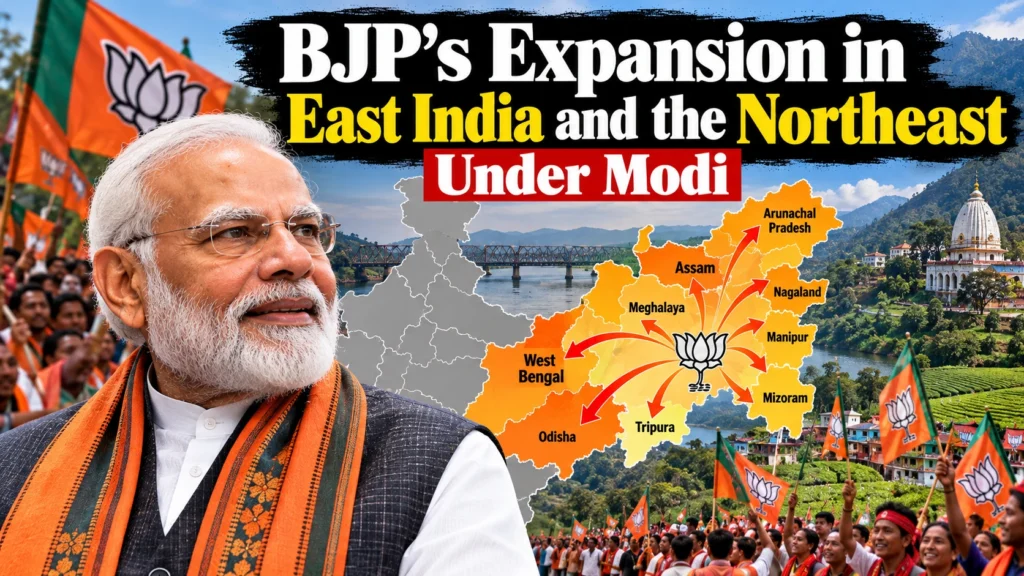
While South India has remained BJP’s toughest region, the East and Northeast tell a strikingly different story: a part of India where the party had almost no historical presence has become one of its most significant expansion successes under Modi. This article covers how that happened.
The Starting Point: A Region Congress Once Dominated
As recently as the 2019 general election, Congress won only 4 of the Northeast’s 25 Lok Sabha seats, 3 in Assam and 1 in Meghalaya, according to figures cited in Deccan Herald’s pre-2024 election coverage, reflecting a region where Congress and various regional and ethnic-identity-based parties had historically dominated far more than BJP, which had limited organisational depth in the area for decades after independence.
Nadda’s Explicit 22-of-25 Target
Ahead of the 2024 general election, BJP president J.P. Nadda set an explicit target of winning 22 of the Northeast’s 25 Lok Sabha seats, according to Deccan Herald’s reporting, instructing state leaders to intensify campaigning specifically in constituencies along the route of the Congress-led Bharat Jodo Nyay Yatra and to foreground both the Ram Temple’s completion and the Modi government’s welfare-scheme record in local messaging, a targeted, top-down campaign directive unusual in its specificity for a region BJP had historically deprioritised.
Also read: Narendra Modi's Role in BJP's Expansion Beyond Its Traditional Base
Assam as the Regional Anchor
Assam has functioned as BJP’s clearest organisational anchor in the Northeast, with Chief Minister Himanta Biswa Sarma, who defected from Congress to BJP in 2015, becoming one of the party’s most prominent regional strategists and, per Pressreader’s coverage of his remarks, explicitly framing the 2024 election cycle as a platform for further BJP expansion across the wider Northeast region beyond Assam’s own borders.
Alliance-Building With Regional and Ethnic Parties
A central feature of BJP’s Northeast strategy, distinct from its approach in most other regions, has been extensive alliance-building with smaller regional and ethnic-identity-based parties rather than attempting to compete against them directly. Deccan Herald’s reporting on the 2024 campaign noted BJP’s formal support arrangements with regional parties in Meghalaya, Manipur, and Nagaland, a coalition-first approach that acknowledges the practical reality that ethnic and tribal identity politics remain more electorally decisive in much of the Northeast than a purely national party identity.
West Bengal and Odisha: The Eastern Flank
Beyond the Northeast proper, BJP has also invested heavily in expanding across West Bengal and Odisha. Odisha marked a particularly significant milestone: the party won the 2024 Odisha state assembly election outright, ending the Biju Janata Dal’s roughly 24-year continuous hold on the state, a result covered in detail on Wikipedia’s dedicated election page and widely seen as one of BJP’s most significant single-state organisational achievements of the 2024 election cycle anywhere in the country. West Bengal, by contrast, has proven considerably more resistant, with the Trinamool Congress under Mamata Banerjee retaining a dominant position despite years of sustained BJP organisational investment and repeated high-profile campaigning by Modi and Amit Shah personally.
Why the Region Became a Priority
Political strategists covering BJP’s regional planning have generally explained the party’s Northeast and eastern focus as a direct response to the practical ceiling BJP has faced in South India: with roughly 84 southern Lok Sabha seats proving stubbornly resistant to durable BJP gains, the party’s path to expanding its national seat total beyond its already-saturated Hindi-belt strongholds has run more plausibly through the Northeast and East, where anti-incumbency against long-serving regional governments (like the BJD in Odisha) and effective local alliance-building offered a more achievable growth path than direct confrontation with entrenched Dravidian or Left political identities in the South.
Read this next: Northeast States and the Centre: Special Packages and Peace Accords
The Cultural and Religious Outreach Dimension
BJP’s eastern and northeastern strategy has also involved specific outreach around religious and tribal identity issues, including engagement with indigenous faith communities on questions of Scheduled Tribe status and religious classification, an approach that has drawn both support from communities the party successfully engaged and criticism from other groups and commentators who have characterised parts of this outreach as attempts to reshape or co-opt distinct indigenous religious identities into a broader Hindutva framework, a genuinely contested characterisation that different communities and observers in the region continue to assess differently.
Infrastructure as a Political Argument
BJP’s messaging in the Northeast has leaned heavily on infrastructure investment as tangible proof of central government attention to a region that had historically felt neglected by Delhi regardless of which party governed nationally, pointing to projects like the Bogibeel Bridge in Assam, expanded rail connectivity into previously underserved hill states, and new highway corridors connecting the region more directly to the rest of India. This infrastructure-first argument has functioned as a complement to the party’s more explicitly political and religious outreach, giving BJP campaigners a concrete, non-ideological talking point, better roads, bridges, and rail links, that has proven easier to sell across the region’s genuinely diverse ethnic and religious communities than messaging built primarily around Hindutva themes that resonate more directly in the Hindi-belt heartland.
Peace Accords as an Organisational Tool
The Modi government’s approach to the Northeast has also involved a series of formal peace accords with insurgent and separatist groups in states including Tripura, Assam, and Nagaland, agreements that BJP has consistently presented as evidence of its capacity to deliver lasting stability to a region that experienced decades of armed conflict under previous governments of various parties. Beyond their direct security significance, these accords have also served an organisational function for BJP, opening political space in areas where armed conflict had previously made conventional party organising difficult or dangerous, allowing the party’s booth-level and membership-drive machinery, discussed elsewhere in this category, to actually establish a physical presence in localities that were effectively unreachable to mainstream party organisers a decade earlier.
Bottom Line
BJP’s expansion into East India and the Northeast under Modi has produced some of the party’s most significant recent organisational gains, anchored by Assam under Himanta Biswa Sarma, an explicit 22-of-25 seat target for the 2024 Northeast Lok Sabha contest, extensive alliance-building with regional and ethnic parties, and a landmark 2024 assembly win in Odisha that ended a 24-year BJD government. West Bengal remains the clear exception, a state where sustained investment has yet to translate into the kind of breakthrough BJP has achieved elsewhere across the wider eastern region.
Disclaimer: This article is based on publicly available news reports listed below. It is written for general informational purposes and does not represent an official statement from the Bharatiya Janata Party.
Sources
FAQ
What seat target did BJP set for the Northeast in 2024?
22 of the region’s 25 Lok Sabha seats, per party president J.P. Nadda’s stated goal.
What was BJP’s biggest single win in the eastern region in 2024?
Winning the Odisha state assembly outright, ending the Biju Janata Dal’s roughly 24-year continuous rule.
Which eastern state has resisted BJP’s expansion the most?
West Bengal, where the Trinamool Congress has retained a dominant position despite years of BJP investment. —