
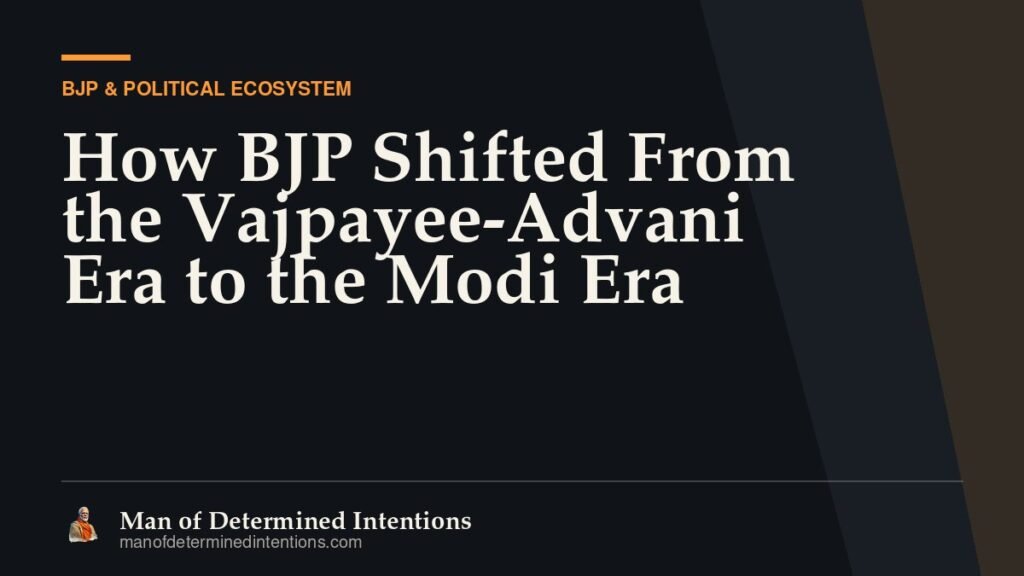
The BJP that governed India from 1998 to 2004 under Atal Bihari Vajpayee looked, in important structural ways, quite different from the party that has governed since 2014. This article traces that shift and the specific moment the transition became decisive.
The Coalition-Dependent Vajpayee Era
Vajpayee served as Prime Minister briefly in 1996 and then continuously from 1998 to 2004, governing through the National Democratic Alliance, a coalition that at its peak included roughly two dozen constituent parties, with Lal Krishna Advani serving as Deputy Prime Minister and Home Minister throughout this period. This heavy coalition dependency is widely documented as having forced BJP to shelve several of its core ideological priorities, including Ram Mandir construction, the abrogation of Jammu and Kashmir’s Article 370 special status, and a Uniform Civil Code, under the terms of the 1998 “National Agenda for Governance” compromise negotiated with coalition partners who did not share BJP’s broader Hindutva-linked agenda on these specific issues.
The Decisive Moment: June to September 2013
The organisational and generational shift toward the Modi era became decisive in 2013. At a BJP national executive meeting in Goa in June 2013, Modi was named chairman of the party’s campaign committee for the upcoming 2014 general election, a move Advani reportedly opposed strongly enough that he resigned from his party posts in protest around June 9-10, 2013, citing concerns about leaders being driven by personal agendas, before being persuaded to withdraw the resignation. The transition was formalised on September 13, 2013, when BJP’s parliamentary board formally declared Modi the party’s Prime Ministerial candidate for the 2014 election, an announcement Advani notably skipped, an episode widely treated by political commentators as the decisive point at which Modi eclipsed Advani within the party’s internal hierarchy.
Also read: How Advani and Vajpayee Shaped Modi's Early Political Career
The “Margdarshak Mandal” and Its Critics
Following the 2014 election victory, senior veteran leaders including Advani, Murli Manohar Joshi, and Jaswant Singh were associated with what the party termed a “Margdarshak Mandal,” or mentor council, an honorary advisory body that notably did not carry cabinet or major decision-making authority. BJP has officially framed this as a respectful, honorary role recognising these leaders’ contributions, while opposition figures and some commentators have more critically described it as a euphemism for effectively sidelining an older generation of leadership from active power.
From Consensus-Coalition to Centralised Majority
Structurally, the post-2014 BJP is widely described by political analysts as considerably more centralised around Modi’s own leadership, with loyalists elevated to key state and organisational positions, compared to the more consensus-driven, coalition-accommodating structure necessary during the Vajpayee years, when BJP alone never held a parliamentary majority and constantly had to negotiate policy compromises with a wide range of coalition partners holding genuinely different ideological priorities.
The 2024 Ironic Return
A notable irony emerged in 2024: after winning outright parliamentary majorities on its own in both 2014, with 282 seats, and 2019, with 303 seats, reducing BJP’s practical dependence on coalition partners for governance decisions, the party fell to 240 seats in 2024, well short of a majority, forcing a return to genuine coalition-dependent governance considerably more reminiscent of the Vajpayee-era NDA than of BJP’s own preceding decade in power, a dynamic covered in more detail in our companion article on NDA coalition management.
Read this next: How Narendra Modi Shifted India's Economic Policy from Socialism to Market Reform
How the Party’s Public Face Changed Alongside Its Structure
Beyond internal organisational shifts, the party’s public messaging and dominant personality also changed noticeably across this transition. The Vajpayee era is generally remembered, including by many BJP supporters themselves, for a more measured, statesman-like public communication style suited to managing a genuinely diverse multi-party coalition, whereas the Modi era’s communication style has been considerably more direct and personality-forward, a shift consistent with the underlying move from consensus-coalition governance toward a leadership structure built more centrally around a single dominant figure’s public image and direct communication with voters.
Why This History Still Shapes Current Coalition Politics
Understanding this earlier Vajpayee-era coalition experience has taken on renewed relevance since 2024, since many of the specific coalition-management skills, patience with ally-specific concessions, willingness to shelve contentious legislation to preserve coalition unity, that defined BJP’s approach during the Vajpayee years are the same skills now being tested again under the current coalition arrangement, giving the party’s own historical experience from two decades earlier a practical relevance to its present governance challenges that might not have seemed likely during the years of outright majority government between 2014 and 2024.
Bottom Line
BJP’s shift from the Vajpayee-Advani era to the Modi era involved both a specific, dateable leadership transition, crystallising in the June to September 2013 period when Modi was named campaign chairman and then Prime Ministerial candidate over Advani’s reported objections, and a broader structural shift from a coalition-dependent, consensus-driven party to a considerably more centralised one built around outright parliamentary majorities in 2014 and 2019. The 2024 election’s coalition-dependent result, following BJP’s fall to 240 seats, has since forced a partial return to the kind of ally-management challenges that defined the earlier Vajpayee period.
Disclaimer: This article is based on publicly available party records and news reports listed below. It is written for general informational purposes and does not represent an official statement from the Bharatiya Janata Party.
FAQ